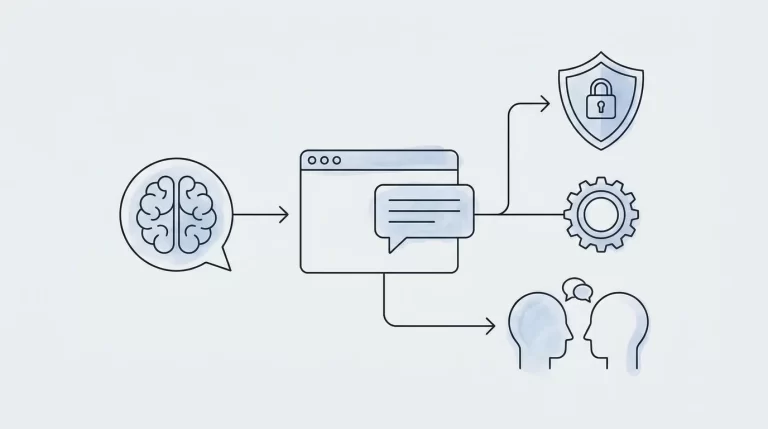
A promising app idea is not yet a proven business. Before investing in complex features, large infrastructure, or a marketing campaign, you need evidence that people want the outcome your product delivers. MVP app development turns assumptions into practical tests, helping you decide what deserves further investment.
1. Define What Your MVP Must Prove
A minimum viable product is the smallest usable version of your product that tests a meaningful business assumption. It is not simply a cheaper app or an unfinished version of your eventual roadmap. Its purpose is to help real users achieve one valuable outcome while showing you whether the underlying idea works.
Start with a specific hypothesis: “Independent fitness coaches will use a shared scheduling tool because coordinating appointments through messages wastes time.” This identifies an audience, a problem, and a proposed change in behavior. “People need a better fitness app” is too broad to guide development.
Next, identify the assumption most likely to invalidate the idea. Perhaps coaches already have adequate scheduling software, or clients resist creating another account. Write down what evidence would support or challenge your hypothesis before building. That makes the MVP a decision-making tool rather than an excuse to ship features and hope for interest.
2. Research the Problem Before Designing the Solution
Talk to people who match your intended customer profile, not just friends who might encourage you. Ask about recent experiences: when the problem last happened, how they handled it, what the workaround involved, and who decides whether to buy a solution. Concrete examples reveal more than hypothetical enthusiasm.
For the coaching app, ask someone to describe how they arranged last week’s appointments. Look for repeated steps, missed messages, scheduling conflicts, and existing subscriptions. If users already spend time or money solving the problem, you have a clearer starting point for evaluating demand.
Avoid leading questions such as “Would you use an app that makes scheduling easier?” Instead, investigate why current options fail and how urgently users want a change. Review competing products and manual alternatives, including spreadsheets and messaging apps. Summarize the findings in a short problem statement, then narrow your initial audience to the group with the clearest unmet need.
3. Test Demand With the Lightest Useful Experiment
You do not always need working software to test the next assumption. A clickable prototype can reveal whether users understand a workflow. A landing page can test whether a clear proposition motivates qualified visitors to request access. A manually delivered service can show whether the promised outcome is valuable.
Choose the experiment according to the question. If you need to test navigation, observe people using a prototype without coaching them. If you need to test demand, offer a specific pilot with clear expectations. If you need to understand service delivery, complete some steps manually before automating them.
Be transparent about what exists. A prototype should not be presented as a functioning product, and a waitlist should not imply immediate availability. Treat sign-ups as an early signal, not proof of sustained use or willingness to pay. Stronger evidence comes when suitable users invest effort, return for another session, or accept an honestly described paid pilot.
4. Scope One Complete User Journey
Once early evidence supports building, define the smallest complete journey that delivers value. For a coaching scheduler, that might mean a coach publishes availability, a client selects a time, and both receive confirmation. Every feature should support that journey or address a necessary operational requirement.
Separate essentials from conveniences. Advanced reporting, loyalty programs, multiple calendar integrations, and extensive customization may wait. However, accurate booking status, appropriate access controls, and a way to resolve failed bookings belong in the initial scope. Minimum scope should not mean careless execution.
Create acceptance criteria for each essential step. For example, two clients must not be able to confirm the same appointment slot. Include empty states, error messages, and basic accessibility rather than designing only the ideal path. Keep deferred ideas in a separate backlog so they do not quietly expand the build. This approach makes trade-offs visible and gives developers a concrete definition of a usable first release.
5. Build for Learning Without Creating Avoidable Rework
The right technical approach depends on what you need to validate. A responsive web app may be sufficient when users need straightforward access through a browser. Native mobile development may be justified when the core experience depends on device capabilities or specific platform behavior. Choose based on the workflow, not assumptions about what an app should look like.
Use established components for routine needs where appropriate, while keeping the differentiating workflow clear and maintainable. Define data ownership, permissions, backups, and basic monitoring early. Avoid collecting information you do not need, and plan how users can get support when something breaks.
You do not need infrastructure designed for a hypothetical massive audience. You do need a foundation that your team can understand and extend. Codeopera’s custom software development services can help translate a validated problem into a focused build, with technical decisions tied to the product’s immediate learning goals and practical operating requirements.
6. Measure Behavior, Not Just Downloads
Before launch, define the events that show whether users receive value. For the scheduling example, account creation is only a starting point. Publishing availability, completing a booking, and arranging another appointment provide more useful evidence. Track the journey between those events to identify where people struggle or stop.
Choose a small measurement set: activation, repeat use, task completion, and payment behavior where relevant. Define each metric precisely. “Active user” is ambiguous; “a coach who completes a booking during the observation period” is actionable. Match that period to the product’s natural usage frequency rather than expecting every app to be used daily.
Combine analytics with interviews and usability sessions. Low completion could reflect unclear instructions, technical errors, or weak demand; a dashboard alone cannot distinguish them. Group users by acquisition source or customer type when useful, and remember that results from a small, enthusiastic pilot may not represent a broader market.
7. Decide Whether to Iterate, Pivot, or Scale
Review results against your original hypothesis, not against the effort already invested. If users reach the core outcome and return, investigate what makes that experience valuable. If they repeatedly abandon the same step, test a targeted improvement. If they understand the product but do not care enough to use it, reconsider the problem or audience.
Make the next release answer a specific question. Simplifying onboarding might test whether setup effort blocks activation. A paid pilot might test whether demonstrated value supports a commercial offer. Avoid changing pricing, positioning, onboarding, and core functionality simultaneously, because you will struggle to identify what influenced the result.
Scale when evidence supports broader investment and the service can handle it reliably. That includes support capacity, dependable delivery, and a credible understanding of acquisition and operating costs. MVP app development succeeds when it reduces uncertainty: sometimes that means expanding, sometimes narrowing the product, and sometimes stopping before a larger investment.